Off-Grid Power for Municipal Water Infrastructure
Engineering an off-grid 48 V system with redundant battery management, load-specific inverter paths, and automated generator charging for a remote water site.
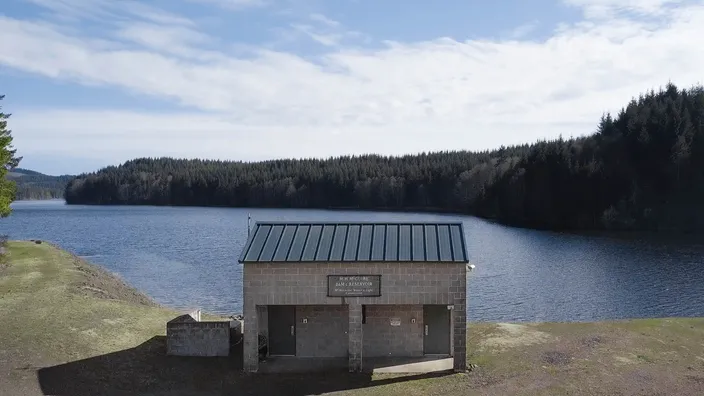
At a remote McMinnville Water & Light catchment site, I worked on the engineering and integration of a fully off-grid 48 V Victron power system. The site is part of the drinking-water supply for more than thirty-five thousand people, and the system exists to keep two things running: the monitoring equipment, and the hydraulic controls that open the valves releasing water to the municipal treatment plant. There is no utility feed to fall back on, and no communication link either, so the system cannot be watched from a desk. It has to govern itself.
Continuous and intermittent loads take separate paths, and the reason is standby power. An inverter consumes power simply by being on, tens of watts for a unit in the 5 kVA class, around the clock, whether or not anything is drawing from it. For a monitoring load that is itself small, keeping two large inverters awake all year to carry it could spend as much of the battery on the inverters as on the monitoring. So a dedicated MultiPlus 2000 supplies the monitoring equipment around the clock, and two MultiPlus 5000 units, configured in split-phase so that their outputs sit 180 degrees apart and give the pump a 120/240 V supply, provide power for the nitrogen accumulation pump and charge the 80 kWh battery system from a generator. That higher-power path runs only on demand. The site’s existing Allen-Bradley PLC wakes it through a digital input only when hydraulic operation is needed, and Node-RED together with the generator-start logic coordinates charging whenever the generator is running.
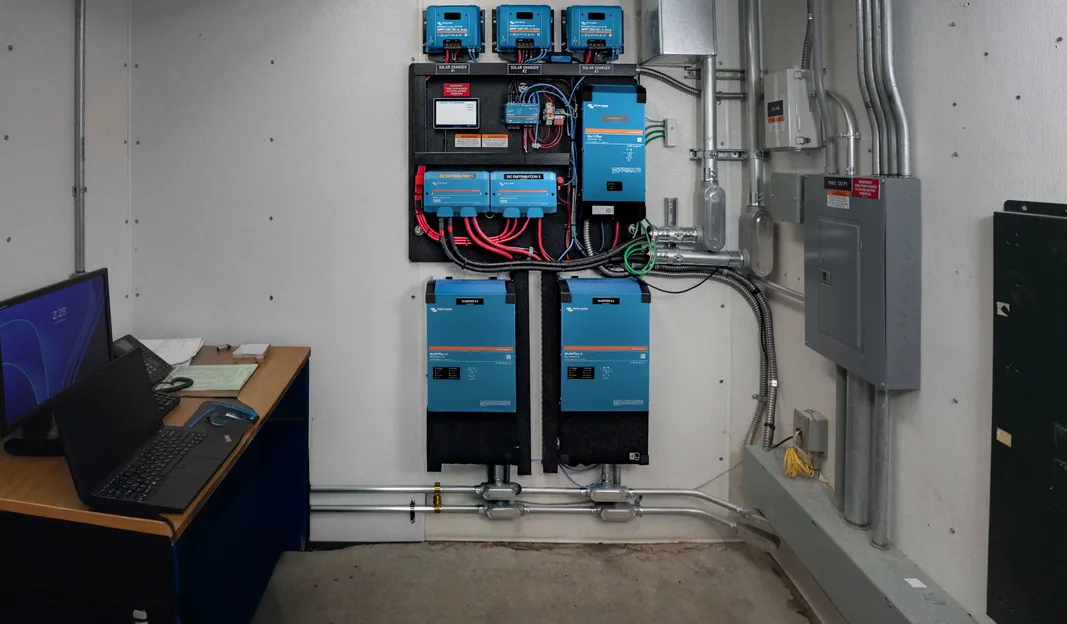
Reliability had to be designed into the physical architecture and the control architecture at the same time, because a fault in either one can stop the water. The battery is Victron Lithium Smart NG, managed by dual Lynx BMS NG units, so that the device whose job is to disconnect the battery to protect it is not itself a single point of failure. Solar charging is divided across three independent paths: a 5 kW array split into three strings, each on its own 250/70 MPPT charge controller, networked over VE.Can so that the BMS can tell every charger what the battery will accept. Shade, a fault, or maintenance on one string leaves two-thirds of the array producing. The array includes module-level rapid shutdown, which brings the conductors from every panel down to a safe voltage on command, so that nobody servicing the site is working around a live DC string in daylight. And the battery equipment is housed in seismically rated Rittal enclosures, because this is Oregon, and a system meant to outlast the grid also has to outlast the ground moving.
What those independent paths buy is a site where maintenance or a single charging-path fault affects one path rather than the whole system, and a system that stays understandable and serviceable in a place that is hard to get to. Redundancy that nobody on site can reason about is just more equipment to fail. The design keeps each path simple enough that the person who drives out to it can see which one is down.
- Critical infrastructure
- Off-grid power
- Power system redundancy
- PLC integration
- Generator automation
- Format
- Critical-infrastructure power integration
- Threads
- Power systems
- Status
- Deployed